Elev8 as a Liquidity Framework: Understanding Macro Context
Elev8 is not just a reversal indicator — it is a liquidity framework. Intraday sweeps often reflect higher-order positioning behaviors that play out across multiple time horizons. When you understand the bigger mechanics behind liquidity, you gain clarity on where and why sweep levels become magnetic.
In this guide, “macro levels” = weekly/monthly extremes and the most visible higher-timeframe boundaries that institutions actually defend.
The core trigger still comes from Elev8+ Pro (levels + sweep signals), but macro clarity improves when you layer the suite: Market Map for higher-timeframe + session structure (your “map”), Market Extremes to identify regime boundaries (avoid mid-range noise), and Momentum Gaps to map rotation checkpoints and targets once a sweep confirms.
The GPS Analogy 🗺️
Think of higher timeframe levels (Weekly, Monthly) as your GPS Map.
Think of intraday sweeps (1m/5m signals) as your turn-by-turn directions.
The best trades occur when your directions (sweep signal) align with the map (major liquidity zone).
- Step 1: Is price interacting with a weekly/monthly boundary OR a dominant session magnet?
- Step 2: Is there evidence of reclaim/rejection (close back inside) rather than acceptance?
Liquidity Pools Are Predictable
Liquidity pools form in predictable locations because traders place stops and breakout orders in predictable ways. Elev8 is built to track these large, obvious pools.
- Prior Day High/Low (The Daily Fence)
- Session Highs/Lows (Asia, London, New York)
- Weekly and Monthly Extremes (The Macro Fences)
These structural anchors shape risk for institutional participants. When a sweep forms directly on one of these anchors, it carries significantly more structural relevance than a random local pivot.
The Impact of Higher Timeframe Magnets
Institutional flows often rotate between higher timeframe liquidity zones as portfolios rebalance. A sweep at a daily, weekly, or monthly boundary typically has more strategic relevance than a sweep at an isolated intraday pivot.
- Clearer Risk: The extreme wick from the sweep provides a precise, hard invalidation point.
- Larger Potential: Rejection from a major level often triggers a rotation back to a distant objective (e.g., Weekly Low → Weekly High).
In many sessions, VWAP acts as the intraday “mean”. Macro sweeps often unwind back toward VWAP first before deciding on continuation.
Optional: Use Market Map to confirm whether the “macro level” you’re reacting to is truly the dominant magnet (nearby HTF level, session structure, VWAP relationship), so you’re not over-weighting minor intraday noise.
Context Filter: Trend Day vs. Range Day
The overall market environment influences how trustworthy a sweep is. You must match the signal to the context.
- Trend Day: Sweeps can be sharp and aggressive, but often fail as continuation takes over. Avoid fading these unless the sweep is at a major higher-timeframe boundary (weekly/monthly).
- Range Day: Sweeps are often cleaner, more controlled, and provide the best mean-reversion setups back to VWAP.
Macro levels still break
A sweep at a weekly/monthly level is not automatically a reversal. If you see multiple closes outside the level and the level holds on pullback (acceptance), treat it as continuation risk—not a fade.
Optional: Market Extremes helps you avoid forcing reversals in the middle of a regime. Your best sweep trades usually form near boundaries; mid-range signals tend to produce chop and stop-outs.
Liquidity Rotation Across Sessions
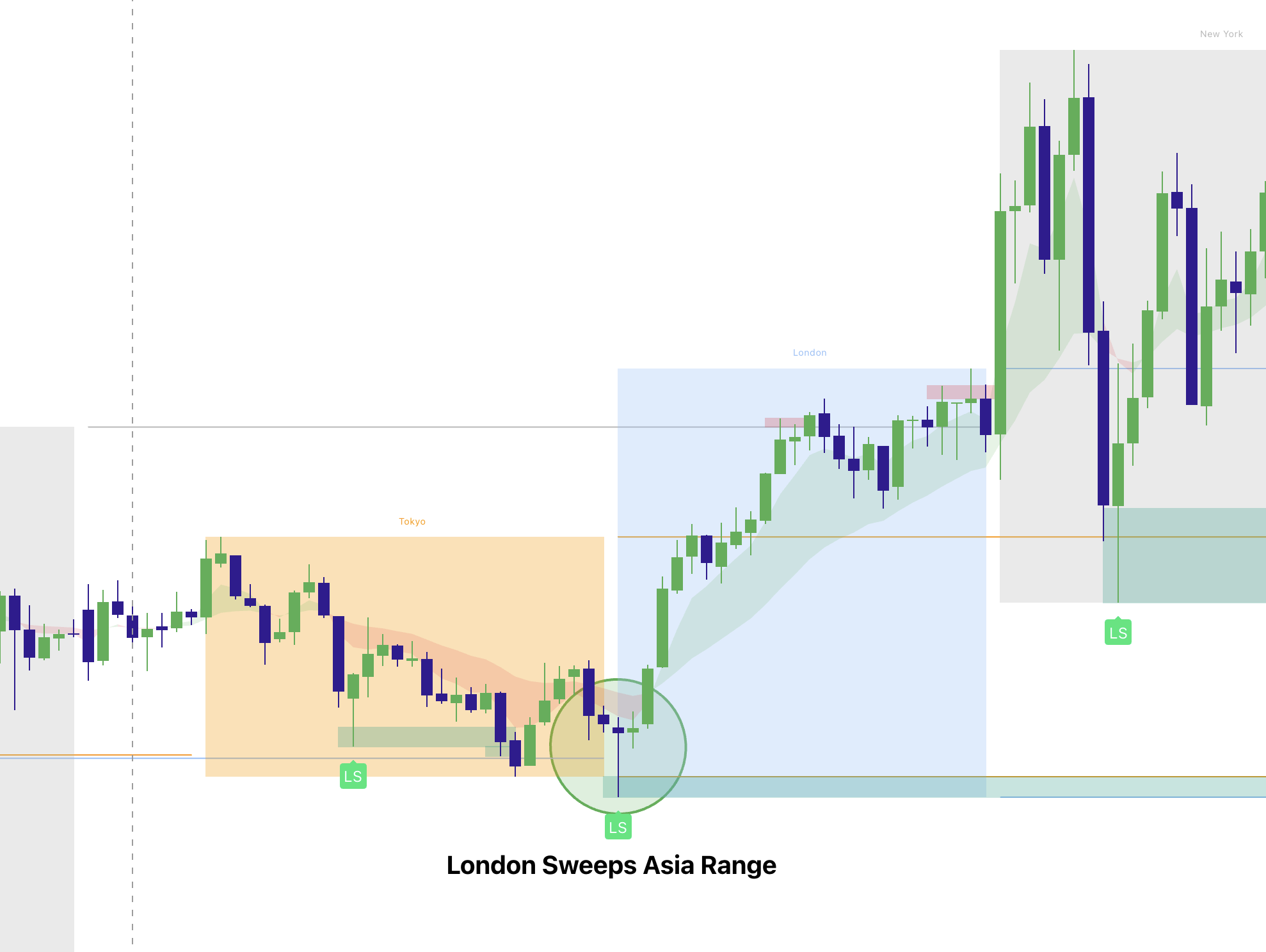
Each major session plays a distinct role in how liquidity is built, harvested, and distributed. When you view the day as a multi-session sequence, Elev8 signals become easier to contextualize.
- Asia: Builds structure and localized liquidity (The Setup).
- London: Tests and sweeps key liquidity (The First Move).
- New York: Confirms and expands the dominant intent (The Follow-Through).
This is a practical framework. The value is in using session context to filter which sweeps deserve attention, not in rigidly predicting the outcome.
When Macro Levels Combine With Intraday Sweeps
The most asymmetric Elev8 environments appear when multiple layers align: Location (Macro Level) + Rejection (Wick) + Confirmation (Elev8 Signal).
- A sweep runs a strong higher timeframe boundary.
- Rejection prints with clean wick behavior.
- Elev8’s premium filters confirm stronger conditions.
In these high-conviction environments, the result is often an inventory transfer, where price is forced to unwind toward VWAP or the opposite structural objective.
Optional: Use Momentum Gaps to map the rotation path after confirmation. It can help define checkpoints for partials (gap zones / inefficiencies) instead of relying only on “feel” once you’re in the trade.
Summary
- Liquidity is harvested most often at predictable higher timeframe magnets.
- The best sweeps are located where your intraday signal meets your macro map.
- Session sequencing helps you anticipate where intent is most likely to be revealed.
- Elev8 provides structural clarity across all timeframes.
The big idea
When you understand how macro liquidity cycles influence sweep locations, Elev8 becomes more than a signal tool. It becomes a full context framework for identifying the most meaningful reversal environments.